Best Women's Erotica of the Year, Volume Two, is starting to get reviews, so you can see what people are saying about the book if you're interested.
I'm particularly pleased at the many descriptors this review had to use to describe my story, "On Some Maps, But Not on Others": "M/F, F/F, S&M, voyeurism." And I'm glad to see love for T.C. Mill and other writers I admire as well.
In this review, I'm described as an author "familiar to erotica fans," which, hey, I guess so! Reminds me of the time, back when I was still fairly embarrassed about writing this stuff, that a woman asked me if my work was "anything she would have seen," and I replied, "Depends on how much erotica you read." I live for the moments I manage to be that witty.
Flippancy aside, I so appreciate everyone who takes the time to read my work and the work of the authors I share pages with. I don't like to comment on the opinions people express, because when I review stuff on Goodreads I like to pretend I'm talking just to other readers—I think that's who reviews are for. But it's a huge help to authors, editors, and publishers, too, when people leave reviews, because many of the websites that sell or recommend books are set up with algorithms that respond to things like quantity or quality of reviews. So if you've picked up or are planning to pick up this year's edition of Best Women's Erotica, please consider leaving a review once you read it. Even a sentence helps.
If you'd like to take a look at the book (or more of its reviews), you can find it here.
I'm posting a review tomorrow for a blog tour, and this seems like a good time to mention that I've decided to stop rating things by number of stars. There are two main reasons:
1. I am fickle.
I have noticed that star ratings are very inconsistent for me. If I read a fun book over the weekend and I was excited and happy, I'll rate it 5 stars. Then, I might really analyze a book, write an intricate review, and in that context decide it is worth 4 stars only (because I am mentally comparing it to War and Peace/the best books I've ever read, etc). The books I've rated 5 stars are frequently not better than the ones I've rated 4 stars. It's very dependent on my purpose in reading and my mood. Looking back at my reviews on Goodreads a few months ago, I realized this bothered me. Publications such as Rolling Stone offer starred ratings and have a consistent system for doing so (I hope). Writing reviews is something I want to do for fun, with recognition that I'm reading some things for fun and some things more seriously, and I don't think that's compatible with the sort of star system that's on Goodreads or Amazon.
2. I'm not comfortable with the way I'm constantly being invited to rate things online.
I love to think and talk about books, movies, music, etc, and that's never going to change. However, I want to do that as a reader and engaged person, not as a consumer. I am weary of receiving e-mail asking me what I thought of whatever thing I just bought (food, book, movie, whatever). I'm not in that rating mode all the time, and I don't think it would be good for my mental health if I were. I don't want to constantly assess whether I've received my money's worth, and I don't think that's the most valuable discussion I can have about a book. This doesn't mean I won't criticize or praise. It means that I'll do it as a person, not as a wallet. The more invitations I've received by e-mail to rate things, the more I've become aware that they threaten to dehumanize both me and whoever created whatever I'm interacting with. Society is full of encouragements to ever higher levels of consumerism, and I think it's good to resist that as much as possible.
And there's one minor reason:
1. As a writer, I've struggled to be receptive to what amounts to a letter grade.
I'm not in school anymore. While I think reviews can be interesting to read, every writer knows that they're also fraught with minefields of impending insecurity. It is much easier for me to read someone's written thoughts, even if they're harsh, than to see my work reduced to a score. I especially struggle when I see a score with no explanation. In general, I try to avoid reading reviews of my own work, but when I can't help but look, I always deal with it better if I don't pay attention to the score. It takes the interaction into that school realm where I feel as if I need to worry about my GPA or something (and the way Goodreads and Amazon compile and average star ratings contribute to that further). If I could change one thing about reviews as a writer, I would take off the stars and letter grades. Since I don't like it myself, I'm going to do unto others.
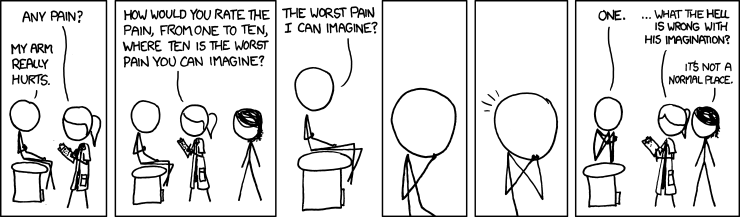
I'll leave you with a comic on the subject of rating systems. I've always really enjoyed this one:
King Evan’s lust and longing for the beautiful but mute Leonora is so poignant, especially when he is faced with a forced marriage to cement his mother’s financial machinations.
Here are three reasons you should visit the site to check out the full version:
I've written in the past about how I think erotica is a sacred calling, but I should expand the statement. Writing about sex is a sacred calling. I spent so long walking around wounded or confused about sex, afraid to say anything. I spent more time not knowing how to share my sexual joys. I love one-handed reading, for sure. But over the past few years, I've also become a huge fan of the Best Sex Writing series, published by Cleis Press.
I'm participating in this year's blog tour for Best Sex Writing 2012, edited by Rachel Kramer Bussel. The writing is honest, challenging, and exciting. There was a piece that really pissed me off and plenty of pieces that got me thinking.
Cleis was kind enough to send me a copy of the book to check it out, so I'm going to do a quick rundown of the pieces that made the biggest impression on me and why.
"Sluts, Walking" by Amanda Marcotte:
"I expect that when a man thinks a woman being sexy means that she isn't smart or deserving of basic respect, you know everything you need to know about him, and he is the one who has forfeited his right to be treated with respect, not the woman he claims provoked him."
Thank you, Amanda Marcotte, for giving a clear, cogent rundown of this issue. I need to hear it to relieve my own twists of thought and my sense of shame. I think we all need to hear it, over and over, until it really sinks in.
"Atheists Do It Better: Why Leaving Religion Leads to Better Sex" by Greta Christina:
"In debates with atheists, many believers argue for religion on the basis of how good it makes them feel. They argue that religion is emotionally useful, psychologically useful, socially useful: that religion gives people a sense of meaning, moral guidance, comfort in hard times, etc. ... But if this argument is to be believed, this usefulness argument is conclusively shown to be bogus--even on its own terms. At least when it comes to sex."
Greta Christina wrote on of my favorite pieces of erotica ever ("Bending," published in Three Kinds of Asking For It), so I was sorry to be so irritated by this piece. While I found the study data Christina cited (about sexual guilt and religion) very interesting, I disliked the essay's evangelical tone. I am a believer, and I've used the utility argument she describes when talking to atheists. But I'll tell you why: because I don't want to get into trying to prove the existence of God to someone. I actually don't want to argue at all (my personal approach to religion). I do believe, however, that God is real. Christina's essay convinced me that I need to be more upfront about that, to avoid disingenuous discussions and irritating treatises that won't convince anyone who isn't already convinced. I probably need to write a whole post on this one, but my brief response is that God and religion are like family to me. They come with a bunch of baggage and guilt, true, but I personally can't escape them. Being raised by my parents left me with a huge need for therapy, but they're still my parents. Religion's in the same category for me.
"I Want You to Want Me" by Hugo Schwyzer:
"So many straight men have no experience of sensing a gaze of outright longing."
One of my favorite pieces in the book. As a woman who has often felt ashamed of my "slutty" desire for the male body, which I've never been able to conceal, it's really interesting to read about the male experience of the female gaze. My partner loves reducing me to speechlessness by revealing his body and this essay gave me a better sense of what's going on with that. As I've written before, I realized at some point that a lot of erotica doesn't really describe the male body. I think it's why a lot of women are drawn to gay porn and m/m writing--we really do like the male body. I would love to live in a world where women felt free to express their true desires.
"Grief, Resilience, and My 66th Birthday Gift" by Joan Price:
"Robert would never touch me again, and I had to find my own way to reclaim the sensual and sexual life within me."
This piece made me cry. It's lovely and brave and I've since been recommending Joan Price's work right and left. I am a young woman, but I find writing by mature women about their sexuality very empowering and comforting, perhaps because it makes it clear that my sexuality isn't something that will just go away once I pass menopause. The wisdom, compassion, and sense of self that were so clear in this essay will all serve me well someday.
"An Unfortunate Discharge Early in My Naval Career" by Tim Elhajj:
"I was about to be forced to tear off the mask I had worn throughout high school. About to stand revealed before the adult world and acknowledge who I really was: a heterosexual male who struggled with authority, an indiscriminate rebel who had a weakness for a little good head."
I love the complexity of sexual identity that Elhajj lays out in his essay. Military officers repeat to him, "You are a homosexual," and his writing makes it clear what an outrage it is for someone else to define your sexual identity for you.
"The Careless Language of Sexual Violence" by Roxane Gay:
"It was an 11-year-old girl whose body was ripped apart, not a town. It was an 11-year-old girl whose life was ripped apart, not the lives of the men who raped her. It is difficult for me to make sense of how anyone could lose sight of that, and yet it isn't."
Another topic, unfortunately, that really needs to be discussed. And thank you to Roxane Gay for a brutally clarifying discussion of rape and what it is and means.
"Penis Gagging, BDSM, and Rape Fantasy: The Truth About Kinky Sexting" by Rachel Kramer Bussel:
"Without the motivation of the person sending and receiving [bits of erotic conversation], you really don't know anything, and yet a default anti-BDSM reaction seems to be acceptable. Our public squeamishness over the fact that some people can eroticize pain, degradation, and being ordered around, safely, consensually, and pleasurably, is nothing more than a prejudice that needs to be eradicated."
I have reams of chat logs that would make a lot of people seriously wonder about me. I like the solidarity of sex writing. When one person speaks up, it lets other people know that what they're doing can't be so terribly weird. I admire the bravery it takes to single yourself out and reveal what's in your bed, your closet, or saved on your computer.
"Adrian's Penis: Care and Handling" by Adrian Colesberry:
"Adrian holds no delusions about women wanting a man to last forever. In his experience, they resoundingly haven't. It's great for those first few times when you just can't get enough of each other, but after that, if you are anything like every woman he's ever been with, you'll be over it."
This piece is hilarious, real, and refreshingly honest. Written in a style that reminds me of David Foster Wallace (complete with footnotes) it is wry, self-deprecating, and friendly, while also cutting to the core of what's so damn uncomfortable about having sex with people who aren't you.
"Love Grenade" by Lidia Yuknavitch:
"We ate each other we ate pickled herring we ate Gruyere cheese. We ate the animal out of each other's bodies we ate steak we ate chocolate two women my chocolate. We drank each other we drank all the beer we drank all the wine we peed outside. We got high on skin and cum and sweat we got high on pot. We came in waves we ran out and into the waves."
Poetic and cutting. I had a hard time picking a quote for this one because you just have to read the whole thing. Quite different from the rest of the pieces in the book because it's much less intellectual. I was glad for it.
***
Looking back, I've written a blurb for more than a third of the pieces in the book and I could easily do more. Every page is well worth reading. I highly recommend it.
For more information about the book, you can visit this page. Here's the book trailer: